Student loan debt continues to be a significant burden for millions of Americans, prompting ongoing discussions and the implementation of various relief programs. As we look towards 2026, understanding the landscape of Student Loan Forgiveness programs is more critical than ever. This comprehensive guide will delve into the eligibility requirements, application processes, and key considerations for borrowers seeking relief from their federal student loans. Whether you’re a recent graduate, a long-time borrower, or someone exploring future options, this article aims to provide clarity and actionable insights.
Anúncios
The federal government has, over the years, introduced and modified numerous programs designed to alleviate the financial strain of student loans. These programs often target specific professions, repayment behaviors, or financial hardships. Staying informed about the latest updates and understanding how these programs function is essential for maximizing your chances of achieving Student Loan Forgiveness. This article will equip you with the knowledge to navigate the complexities of these programs effectively.
Understanding the Core of Student Loan Forgiveness
Before diving into specific programs, it’s crucial to grasp the fundamental concept of Student Loan Forgiveness. In essence, it means that you are no longer required to repay some or all of your federal student loan debt. This is distinct from deferment or forbearance, where payments are temporarily paused but the interest may still accrue, and the principal remains. Forgiveness, on the other hand, permanently erases a portion or the entirety of your debt. However, it’s vital to note that most forgiveness programs apply exclusively to federal student loans, not private ones. Private student loan forgiveness is exceedingly rare and typically only occurs in very specific circumstances, such as borrower death or permanent disability, and is often at the discretion of the lender.
The landscape of Student Loan Forgiveness is dynamic, with policies and eligibility criteria subject to change based on legislative actions and administrative decisions. Therefore, the information provided here reflects the most current understanding as we approach 2026, but borrowers should always verify details with official sources like the U.S. Department of Education or their loan servicer.
Anúncios
Key Types of Federal Student Loans Eligible for Forgiveness
Not all federal student loans are treated equally when it comes to forgiveness. Generally, Direct Loans (Subsidized, Unsubsidized, PLUS, and Consolidation Loans) are the most commonly eligible. Federal Family Education Loan (FFEL) Program loans and Perkins Loans may also qualify, but often require consolidation into a Direct Consolidation Loan first. It’s imperative to identify your loan type to determine your eligibility for various Student Loan Forgiveness programs. You can find this information by logging into your account on the Federal Student Aid (FSA) website.
Public Service Loan Forgiveness (PSLF) in 2026
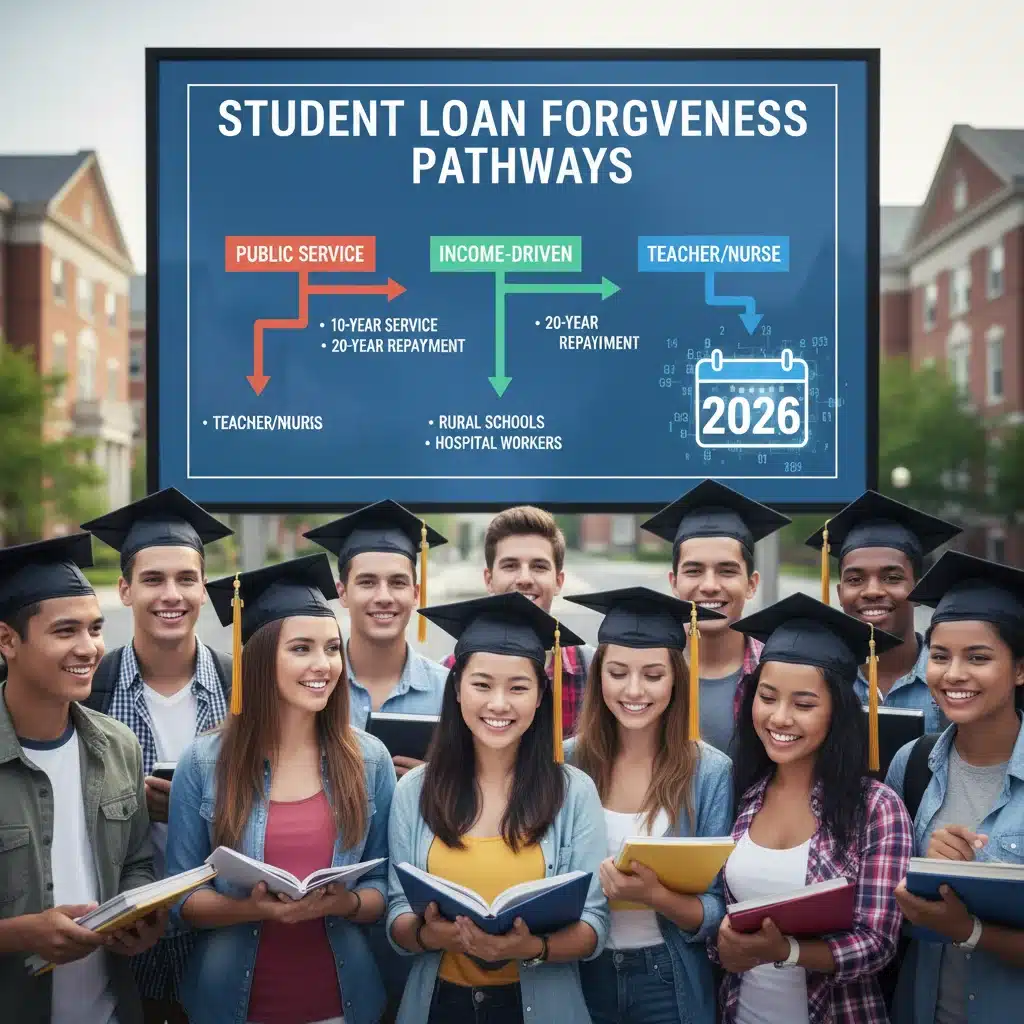
The Public Service Loan Forgiveness (PSLF) program is one of the most well-known and impactful avenues for Student Loan Forgiveness. Designed to encourage individuals to enter and remain in public service careers, PSLF offers forgiveness of the remaining balance on Direct Loans after 120 qualifying monthly payments have been made under a qualifying repayment plan while working full-time for a qualifying employer.
Eligibility Criteria for PSLF
To qualify for PSLF in 2026, several stringent criteria must be met:
- Qualifying Employment: You must be employed full-time by a U.S. federal, state, local, or tribal government organization (including the military), or a not-for-profit organization that is tax-exempt under Section 501(c)(3) of the Internal Revenue Code. Other non-profit organizations that provide certain public services may also qualify.
- Qualifying Loans: Only Direct Loans are eligible. If you have FFEL or Perkins Loans, you must consolidate them into a Direct Consolidation Loan.
- Qualifying Payments: You must make 120 qualifying monthly payments. These payments must be made on time (no later than 15 days after your due date), for the full amount due, and while you are employed full-time by a qualifying employer. Payments made under an Income-Driven Repayment (IDR) plan are typically qualifying payments.
- Qualifying Repayment Plan: You must be on an income-driven repayment (IDR) plan (e.g., REPAYE, PAYE, IBR, ICR) or the 10-year Standard Repayment Plan. While the 10-year Standard Repayment Plan also qualifies, it generally results in the loan being paid off before reaching 120 payments, leaving nothing to forgive.
The PSLF Application Process
The PSLF application process involves two main steps:
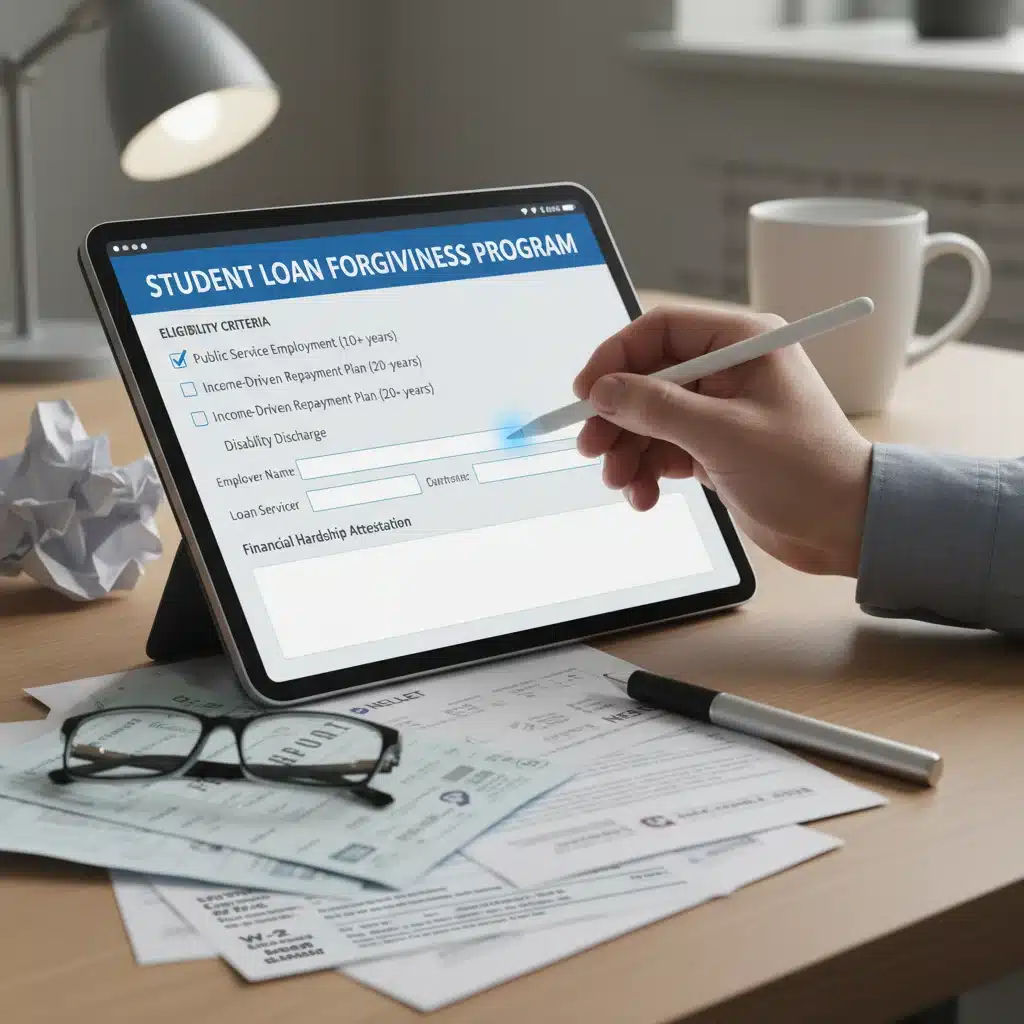
- Submitting the PSLF & TEPSLF Certification & Application (PSLF Form): This form should be submitted annually or whenever you change employers. It helps track your qualifying employment and payments. While not strictly required annually, it is highly recommended to ensure your employment and payments are being correctly counted by your loan servicer.
- Applying for Forgiveness: Once you have made 120 qualifying payments, you will submit the same PSLF Form, indicating that you believe you have met the requirements for forgiveness.
It’s crucial to use the PSLF Help Tool on the FSA website to help you complete and submit your forms. This tool can verify your employer’s eligibility and help you track your progress toward Student Loan Forgiveness. Keeping meticulous records of your employment and payments is also highly advisable.
Income-Driven Repayment (IDR) Plan Forgiveness in 2026
Income-Driven Repayment (IDR) plans are designed to make federal student loan payments more affordable by basing them on your income and family size. A significant benefit of these plans is that any remaining loan balance is forgiven after a certain number of years (typically 20 or 25 years) of qualifying payments.
Overview of IDR Plans
There are several IDR plans available:
- Revised Pay As You Earn (REPAYE) Plan: Generally sets payments at 10% of your discretionary income. Forgives remaining balance after 20 years for undergraduate loans and 25 years for graduate loans.
- Pay As You Earn (PAYE) Plan: Generally sets payments at 10% of your discretionary income, but never more than the 10-year Standard Repayment Plan amount. Forgives remaining balance after 20 years.
- Income-Based Repayment (IBR) Plan: Payments are generally 10% or 15% of your discretionary income, depending on when you took out your loans, and never more than the 10-year Standard Repayment Plan amount. Forgives remaining balance after 20 or 25 years.
- Income-Contingent Repayment (ICR) Plan: Payments are either 20% of your discretionary income or what you would pay on a repayment plan with a fixed payment over 12 years, adjusted according to your income, whichever is less. Forgives remaining balance after 25 years.
Each IDR plan has specific eligibility requirements, often related to your income relative to your loan balance. It’s important to choose the plan that best suits your financial situation and long-term goals for Student Loan Forgiveness.
The IDR Forgiveness Process
Unlike PSLF, which requires specific employment, IDR forgiveness is tied solely to making consistent payments under a qualifying IDR plan for the required duration. You must recertify your income and family size annually to remain on an IDR plan. Failing to do so can lead to higher payments and potentially capitalize unpaid interest, which could impact your total forgiveness amount.
As of recent changes and ongoing discussions, there have been efforts to address past administrative errors in counting IDR payments. Borrowers should regularly check their payment counts on the FSA website and with their servicer to ensure accuracy. Any remaining balance forgiven under an IDR plan may be considered taxable income by the IRS, unless Congress acts to make it tax-free, as has been the case with some past forgiveness initiatives. This is a crucial consideration for borrowers planning for IDR Student Loan Forgiveness.
Teacher Loan Forgiveness (TLF) in 2026
The Teacher Loan Forgiveness (TLF) program is designed to encourage individuals to teach in low-income schools or educational service agencies. It offers up to $17,500 in forgiveness for Direct Subsidized and Unsubsidized Loans and certain FFEL Program loans.
TLF Eligibility Criteria
To qualify for TLF:
- You must teach full-time for five complete and consecutive academic years in a low-income school or educational service agency.
- You must be a highly qualified teacher.
- The loans for which you are seeking forgiveness must have been made before the end of your five academic years of qualifying teaching service.
The amount of forgiveness depends on the subject you teach. Highly qualified mathematics and science teachers at the secondary level, and highly qualified special education teachers at the elementary or secondary level, may qualify for up to $17,500 in forgiveness. Other eligible highly qualified teachers may receive up to $5,000 in Student Loan Forgiveness.
Applying for TLF
After completing your five years of qualifying teaching service, you must apply for TLF through your loan servicer by submitting the Teacher Loan Forgiveness Application. Your school’s chief administrative officer must certify your employment on the form.
Other Federal Student Loan Forgiveness Programs in 2026
Beyond PSLF, IDR, and TLF, several other programs offer specialized Student Loan Forgiveness or discharge options.
Total and Permanent Disability (TPD) Discharge
If you become totally and permanently disabled, you may be eligible for a Total and Permanent Disability (TPD) Discharge of your federal student loans. Eligibility can be proven through documentation from the Department of Veterans Affairs (VA), the Social Security Administration (SSA), or a physician.
Borrower Defense to Repayment Discharge
This program offers Student Loan Forgiveness to borrowers whose schools engaged in misconduct, such as misrepresentation of job placement rates or program quality. The process involves submitting an application to the U.S. Department of Education, providing evidence of the school’s misconduct. Eligibility and the amount of forgiveness can vary significantly based on the specifics of each claim.
Closed School Discharge
If your school closes while you are enrolled or soon after you withdraw, you may be eligible for a Closed School Discharge, which forgives your federal student loans related to that school. This generally applies if you could not complete your program because of the closure and did not transfer your credits to another school.
Death Discharge
Federal student loans are discharged if the borrower dies. This also applies to PLUS loans if the student on whose behalf the parent borrowed dies. Proper documentation, such as a death certificate, is required.
Navigating Potential Changes and Updates for 2026
The landscape of Student Loan Forgiveness is constantly evolving. Borrowers should be prepared for potential changes due to new legislation, administrative actions, or economic shifts. Here are some critical areas to monitor:
- Legislative Reforms: Congress may introduce new bills or modify existing laws that impact student loan programs. These could include changes to eligibility criteria, forgiveness amounts, or the creation of new relief initiatives.
- Administrative Actions: The U.S. Department of Education frequently updates guidance and implements new rules for existing programs. These administrative changes can affect how payments are counted, how applications are processed, and other operational aspects of Student Loan Forgiveness.
- Tax Implications: As mentioned, IDR forgiveness currently may be considered taxable income. While past forgiveness events have sometimes been made tax-free by Congress, this is not guaranteed for future forgiveness. Borrowers should consult with a tax professional to understand the potential tax consequences of any forgiven debt.
- Economic Conditions: Broader economic conditions can influence political will and public demand for student loan relief, potentially leading to new programs or adjustments to existing ones.
Staying informed by regularly checking official government websites (such as StudentAid.gov) and reputable financial news sources is crucial for any borrower pursuing Student Loan Forgiveness.
Essential Tips for Maximizing Your Chances of Forgiveness
Achieving Student Loan Forgiveness requires diligence, organization, and proactive engagement with your loan servicer and the Department of Education. Here are some essential tips:
1. Know Your Loan Types
As emphasized earlier, the first step is always to identify whether your loans are federal or private, and if federal, what type they are. This dictates which forgiveness programs you might qualify for. Visit StudentAid.gov to view your loan history.
2. Keep Meticulous Records
For programs like PSLF, maintaining detailed records of your employment, payment history, and any correspondence with your loan servicer is paramount. This includes pay stubs, W-2 forms, employment certification forms, and confirmation of payments. These records can be invaluable if discrepancies arise.
3. Stay on Top of Annual Certifications
For IDR plans, annual recertification of your income and family size is mandatory. Missing this deadline can lead to your payments increasing significantly and potentially capitalizing unpaid interest, which adds to your principal balance. For PSLF, submitting the PSLF Form annually is highly recommended to track your progress and address any issues early.
4. Communicate with Your Loan Servicer
Your loan servicer is your primary point of contact for managing your loans. Don’t hesitate to reach out to them with questions about your eligibility, payment counts, or application status. However, always document your conversations, including dates, times, and the names of representatives you speak with.
5. Understand Tax Implications
For certain types of forgiveness, the forgiven amount may be considered taxable income. It is crucial to consult with a tax professional to understand the potential impact on your tax liability, especially for IDR forgiveness.
6. Beware of Scams
Unfortunately, the student loan landscape is ripe for scams. Be extremely wary of companies that promise guaranteed Student Loan Forgiveness for a fee, ask for your FSA ID, or pressure you to act quickly. Most legitimate services for federal student loans are free through the Department of Education or your loan servicer. If something sounds too good to be true, it likely is.
7. Use Official Resources
Always rely on official sources for information: StudentAid.gov, the websites of your loan servicer, and the U.S. Department of Education. These are the most accurate and up-to-date resources for federal Student Loan Forgiveness programs.
The Future of Student Loan Forgiveness
As 2026 approaches, the discussion around student loan debt and forgiveness will undoubtedly continue. While broad, sweeping forgiveness initiatives have been proposed and, in some cases, implemented on a limited basis, the long-term outlook for such programs remains uncertain. However, the established programs like PSLF and IDR forgiveness are foundational components of federal student aid and are likely to persist, albeit with potential refinements.
Borrowers should focus on understanding and utilizing the existing pathways to Student Loan Forgiveness. By being informed, organized, and proactive, you can significantly improve your chances of reducing your student loan burden. The journey to financial freedom from student debt can be challenging, but with the right knowledge and strategy, it is achievable.
It’s important to reiterate that this article focuses on federal student loans. Private student loans typically do not offer forgiveness options outside of extreme circumstances and are governed by the terms set by the private lender. If you have private student loans, your options for relief are generally limited to refinancing, which might lower your interest rate or monthly payments, but does not offer forgiveness.
In conclusion, the path to Student Loan Forgiveness in 2026 is multifaceted, requiring careful consideration of your loan types, employment, income, and repayment history. By diligently following the guidelines for programs like PSLF, IDR, and TLF, and staying informed about any policy changes, borrowers can work towards a future with less student loan debt. Empower yourself with knowledge, take advantage of available resources, and don’t hesitate to seek professional advice when needed.